Urban Itineraries
MAHÓN
Urban Itineraries of Mahón
- City Hall:
This is a building inaugurated in the year 1613; it was profoundly reformed in the year 1789 during the period of Spanish rule in the 18th century by the military engineer Francisco Fernández de Angulo. The building was provisionally inaugurated in the month of February 1789, on the occasion of the proclamation of Charles IV, but the construction work was not finished until the month of May. The most important part of the building is the Noble Hall, where plenary sessions and protocol acts are held. Notable are the Venetian chandelier and the Gallery of Illustrious Menorcans, created in the last century.

- Principal de Guardia:
This building was used as a guardhouse by the British during the 18th century. It was remodeled in 1786 in the same style, incorporating the color red on the facades and decorated with military trophies.
- Church of Santa María:
It was built in the 18th century on the site of a 13th-century Gothic church. The interior is of neo-Gothic inspiration and houses a monumental organ built in 1810 by the Swiss maker Kyburz; of great instrumental and artistic quality, it is one of the best of its era.
- Monument to Alfonso III:
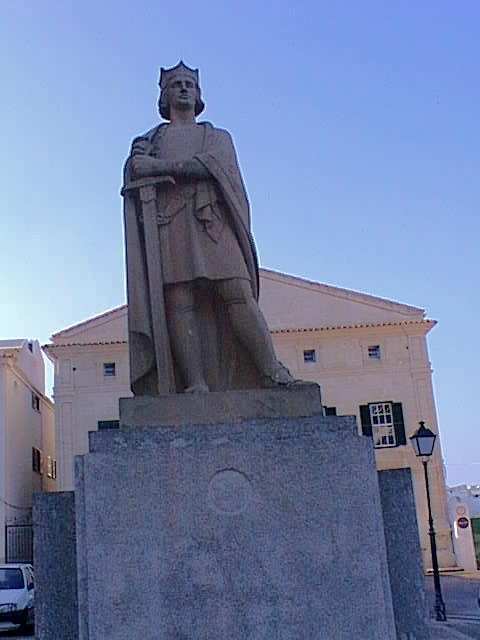
In the "Conquesta" square, behind the church of Santa María, we will find a statue erected in 1950 in memory of King Alfonso III of Aragon, who conquered Menorca from the Muslims in 1287. The statue is the work of the Catalan sculptor Federic Marès.
- Public Library:
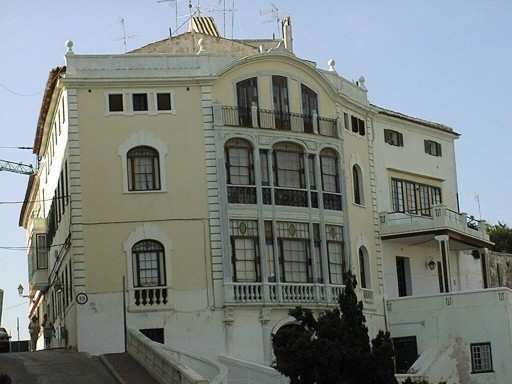
Located in the former 18th-century palace of the Mercadal family in the "Conquesta" square, built in 1761 over medieval constructions. It was designated as a Cultural Center in 1953 and currently houses the Public Library and the historical archive.
- Pont des Castell Viewpoint:
Together with the "Conquesta" square and the houses that surround it, this viewpoint over the port of Maó forms part of the oldest nucleus of the city and is known as Pont des Castell.
Urban Itineraries II
- Church and Convent of the Conception:
Built on the grounds of the old wall between 1616 and 1623, this is a cloistered convent dedicated to the Immaculate Conception.
- Isabel II Street:
This street concentrates the largest number of manor houses built in Maó during the 18th century. There is the parish house, then the Pons i Soler house with beautiful paintings inside, the Olivar house, the house of the renowned linguist of the time Antonio Febrer i Cardona, next to it the Albertí house, and in front, the current Military Government (9), the former house of the King, converted into a governor's palace by the British and known by the townspeople as Cas General. The Vidal house has ceilings painted by the local artist Pasqual Calbó i Caldés. There are four houses marked by illustrious children of the city: the naturalist Joaquim Rodríguez i Femenias, the architect Nicolau Rubió i Tudurí, the novelist Màrius Verdaguer, and the industrialist Francesc F. Andreu Femenias.

- Church of Saint Francis:
Built in the 18th century over a previous Gothic temple, the Church of Saint Francis is located in the square that also bears its name, at the end of Isabel II Street and next to the Museum of Menorca. It is a structure with a solid facade from the early 19th century; noteworthy in its interior is the decoration of helical arches and columns, and the Chapel of the Conception, in a Baroque style.
- Museum of Menorca:
This is a former Franciscan convent in a grand Baroque style. It was disentailed in 1835 and has since served as the headquarters for public institutions such as: the Nautical School, the Public Library, the High School, and the Charity House. It has been the Museum of Menorca for the last twenty years.
Urban Itineraries III
- Church of Saint Anthony:
Going up s'Arraval street, past the Pont de Sant Roc, we will find a church on the right that was a medieval hermitage outside the walls, becoming integrated into the urban nucleus with the city's expansion in the 17th century. The current facade with neoclassical lines dates from 1790. It is currently the Cultural Hall of the Caixa de Pensions de Balears "Sa Nostra". Just in front of this church was the birthplace of the lawyer, historian, and one of the greatest playwrights of 18th-century Catalan literature.
- Pont de Sant Roc:
The portal of Sant Roc, the only vestige of that old wall, was the gate through which paths led toward the interior of the island, in the direction of San Clemente and Ciutadella. Its construction likely dates back to the 14th century, prompted by the Royal Order of Peter IV, which ordered the fortification of the new area of "la Raval" with stone and cement walls. The portal, in the Gothic style, has undergone numerous reforms throughout history; the most important was carried out after the assault by the Turks on the city of Maó in 1535.

- Sant Roc Street:
On this street, the manor houses of the Vidal family stand out, as well as that of the Baron of Las Arenas, currently converted into a cinema, of which only the facade is preserved, with a typical balcony of French Baroque inspiration; a little further on is the Olives house, an example of Maonese architecture.
- Monument to Dr. Orfila:
On the street of Ses Moreres, the main promenade of this neighborhood, urbanized in the 18th century, there is a monument dedicated to Dr. Orfila, right in front of the birthplace of this illustrious Maonese. This monument was built by the artist Federic Màres and created in 1953 in homage to one of the greatest European scientists of the 19th century, the doctor and chemist Dr. Orfila.

- Principal Theater:
Built according to the schemes and decoration of 18th-century Italian theaters in 1829 by the architect, writer, and singer Giovani Palagi, it has hosted the world's greatest opera singers and is also the headquarters for the island's love for opera. A few years ago, it underwent one of the most important restorations of the several it has had throughout its long and splendid history. Consequently, it is currently a theater with a great past, but with modern facilities, as it features almost all current technologies in terms of safety and quality for the public, as well as technology for the performance of the most varied shows.
Urban Itineraries IV
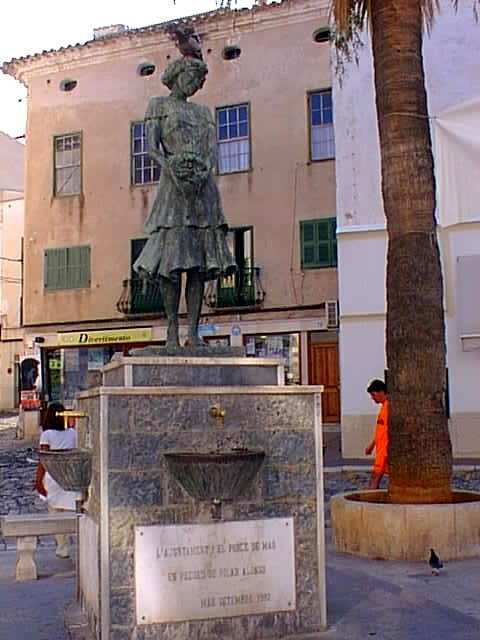
- Monument to Pilar Alonso:
When we arrive at Colón square, we will find a monument in memory of the Maonese cuplet singer Pilar Alonso. Going down Hannover Street, before reaching this monument, at the very top we can see the famous "bow window" of the Moncada house and, further down on Bonaire street, is the Cardona house, which was distinguished with the Chamber of Urban Property award in 1931.
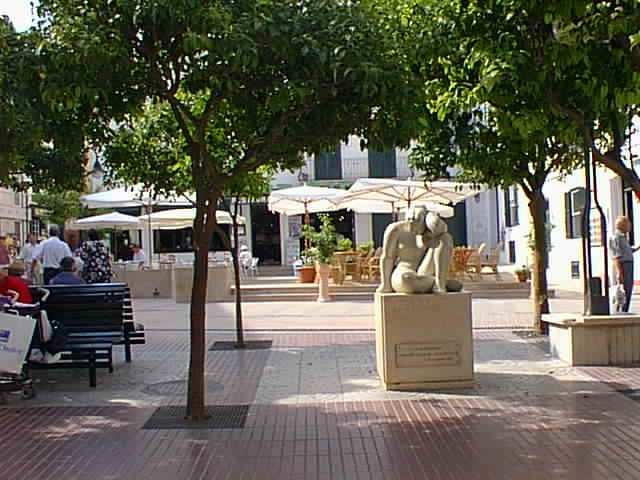
- “Mediterrània” Sculpture:
When we enter Carrer Nou, one of the main commercial streets of the city, we will find at the end of this street, in front of the busy Reial square, the Mediterrània sculpture, work of the Ciutadella sculptor Joana Olives.
- Es Freginal:
This is an old ravine that, due to the conditions of the terrain, was never urbanized and remained in the middle of the city. In the 70s, this urban park became municipal property and was converted into one of the most important green zones of the city. It has access from Deià street and Ramón y Cajal street.
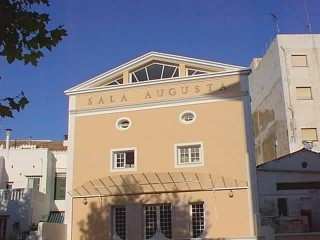
- Augusta Hall:
Built as a cinema in the 40s, it is the most modern of the Maó theaters and soon became the Augusta Hall. It became municipal in 1984 and was remodeled as a multi-purpose hall.
- Church of the Conception:
Located on Cos de Gràcia street, the Church of the Conception was built in 1749 by the Greek colony established in Maó, dedicated to the Orthodox rite under the invocation of Saint Nicholas of Bari. This church with a Greek cross plan and Byzantine style had various uses after the expulsion of the Greeks in 1782. In 1868, its facade was reformed, eliminating the Orthodox symbols, and it became a Catholic church that same year.
Urban Itineraries V
- Palacio Oliver:
This palace, built by the Oliver family in the early 19th century, stands out for the neoclassical lines of its facades and for the ceiling paintings created by Italian artists of the period.
- Plaza del Príncipe:
We arrive at Plaza del Príncipe by taking Calle Anunciavay, where many 19th-century houses are located. Notable in this square is Casa Soler, built in the early 19th century and today occupied by the Casino Mahonés. Also here is Casa Martorell, which was renovated by the architect Femenias in 1913 and served as the headquarters of the Ateneo Mahonés for several years.
- Casa del Pueblo and former headquarters of the Consell Insular de Menorca:
If we head down the Camí des Castell, we will find the old Casa del Pueblo, which was also designed by the architect Femenias as the former headquarters of the Casino Republicano. This house was bombed during the Civil War and seized in 1939. Since 1991, it has become a center for the elderly. Almost directly opposite, we find the headquarters of the Consell Insular de Menorca, located in a grand 19th-century house.
- Iglesia del Carmen:
The Carmelite friars obtained authorization from the English government to build a church and a convent for their order in Mahón after many years of negotiation. The neoclassical building was constructed in 1750, with work lasting 70 years, and it is the largest church in Mahón.

- Claustro del Carmen:
Built parallel to the church is the Claustro del Carmen, where the set of sculpted ledges on the ground floor stands out. This cloister was confiscated in 1835 under Mendizábal. The cloister became municipal property and, over time, has served various purposes, such as a prison, a courthouse, a public school, and a meat and vegetable market. It is one of the city's architectural landmarks and generally retains its original construction lines.
- Fish Market and Plaza España:
The fish market building, a work by Francesc Femenias in 1927, is built on an old 18th-century bastion; it has a rectangular shape with an interior courtyard and a central pavilion. Plaza España was also designed during that period. The highest point of the square stands out, offering a magnificent view of the port of Mahón. Also notable is Casa Mir, a house of Mahón's modernism.