


Biosphere Reserve
Menorca, a great natural park
All of Menorca is a large natural park, especially for the occasional visitor who sees a place so natural and tranquil just a stone's throw from the populous and frantic European cities; therefore, we hope it will remain so for future generations. However, the standout area of Menorca, for constituting in itself a representative and indivisible whole like few others, is the s'Albufera d'es Grau, illa d'en Colom, and Cap de Favàritx natural park. It is located in the east of the island and includes the most important wetland area in Menorca. Near the coast is the illa d'en Colom, which is an indivisible part of the natural park. Due to its value and interest, this area is the central nucleus of the Biosphere Reserve under the UNESCO MAB program, which encompasses the entire island of Menorca. It is a Natural Park with three well-defined areas, each formed by a great variety of ecosystems: wetlands, grazing and cultivated lands, wooded hills, coastal communities, cliffs, dunes, and beaches. Its natural, landscape, and ethnological values have made the area deserving of being a natural park, and by adding the other attributes, all of Menorca is a UNESCO "Biosphere Reserve." Park objectives: * The conservation and improvement of its natural, landscape, and ethnological heritage. * The public and educational dissemination of the values of this important natural heritage. * The harmonization of legally permitted uses in order to conserve the values of the s'Albufera d'es Grau park.
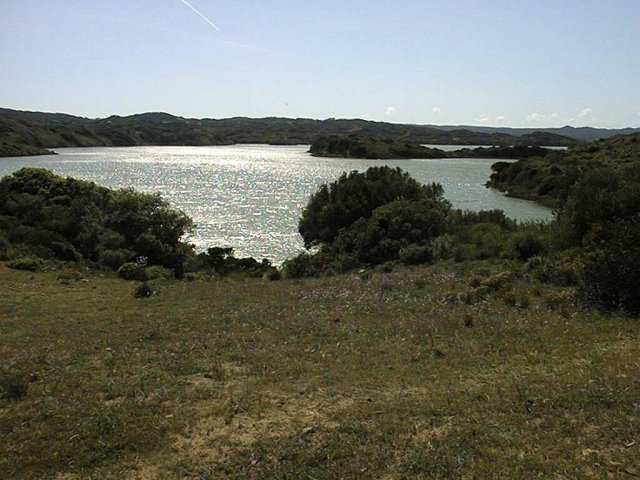
S'Albufera d'es Grau is a lagoon 2 km long with an area of about 70 hectares, located at sea level and closed off by a dune system that allows it to drain into the Mediterranean via a single, narrow canal, like a river, the "Gola." The mirror of water is dotted with small islands, an unbeatable refuge for birds as they remain undisturbed, with some vegetation; they are green spots in a blue lake. The "Prat" (meadow) is an area that is the expression of the park's life, since, like a heartbeat, it floods or dries out depending on the season and the water level of the lake.
The illa d'en Colom
Separated from the coast by barely 200 meters, the islet has an area of 60 hectares, and its utility has varied over time; it was used as a lazaretto, part of it was cultivated, and a lead mine was operated there with little success. Currently, its use is tourist-oriented, mainly for bathers and occasional visitors who arrive in pleasure boats. The island itself is currently uninhabited. We remind you that visiting the interior of the illa d'en Colom is not permitted; it is only possible to visit its beaches.
First plant manifestation on the beach
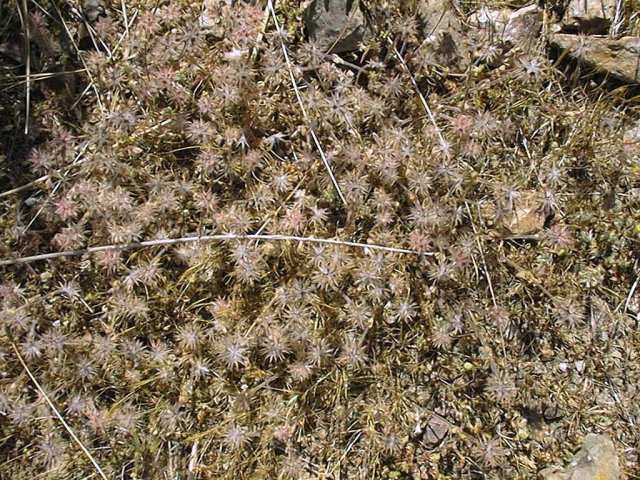
From the beach towards the interior, the first group of plants is a group of herbs, not very dense or tall, unable to stop the wind's effect. Some plants form a kind of "creeping lawn," such as Medicago marina. We also easily observe the sea holly (Eryngium maritimum), sea spurge (Euphorbia paralias), sea daffodil (Pancratium maritimum), or beach grass (Ammophila arenaria), a grass that crowns and fixes the first mounds of sand.
The western end of the beach
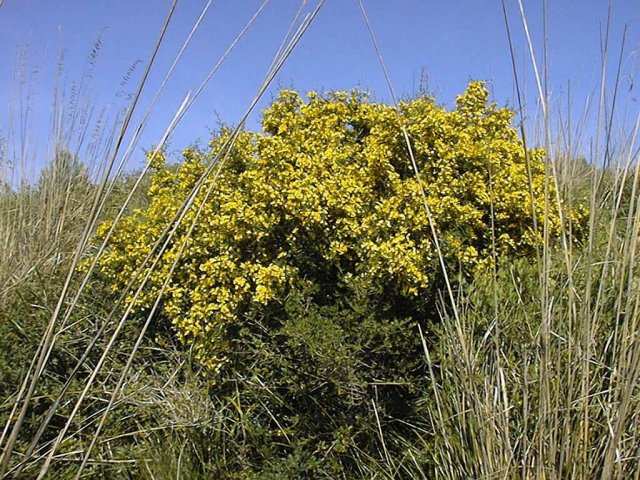
The vegetation has a different stature relative to the substrate, which instead of sand is soil and more consistent; although it is protected from the prevailing wind, it receives the influence of sea salt. Despite being an environment differentiated from the beach, the strip of land is quite narrow. Regarding the plants, near the water, we recognize the rock samphire (Crithmum maritimum), spiny sea lavender—some endemic—and some herbs like the Limonium ssp. Further inland, the stature of the plants increases in height, volume, and density. If the wind is not very constant, a thick scrub of low or medium-height bushes grows. Among the most representative plants, we see the lavender cotton (Santolina chamaecyparissus subsp. magonica), which tends to grow in the marginal positional zones of the thicket; and others such as the Montpellier cistus (Cistus monspeliensis), the endemic Phillyrea (Phillyrea media), the spiny broom (Calycotome spinosa), the tall grass (Ampelodesma mauritanica), etc. Blending with the coastal scrub, but further inland and away from the sea's saline effect, we can identify another plant community. It is the group of plants that form the wild olive forest. It is found especially on the tops of orographic elevations and tends to develop better oriented towards the south or slopes not punished by the Tramuntana (north) wind. It often takes on shrubby forms, difficult to traverse, but when it has favorable conditions to grow, it reaches the height of a small forest that can reach seven meters. We must not forget that, together with the holm oak forest, it is the plant community best adapted to the environmental conditions of Menorca, which is why it is very abundant. The most representative plants are: the wild olive (Olea europaea var. sylvestris), the common smilax (Smilax aspera), the shrubby spurge (Euphorbia dendroides), the wild asparagus (Asparagus acutifolius), and others mentioned in plant groups later on.
The interior of the dunes
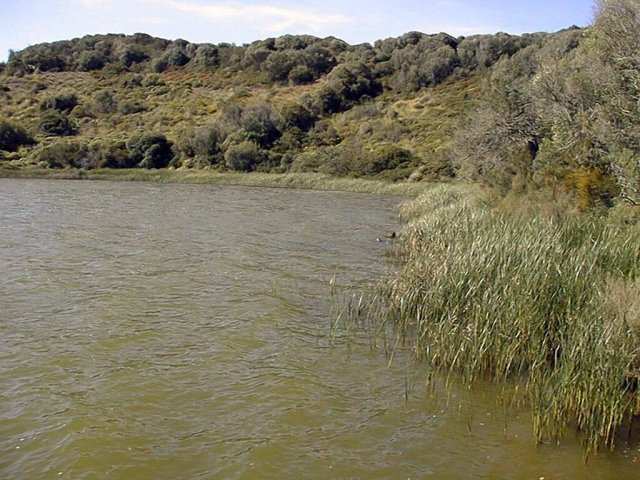
Moving away from the sea, we observe that the vegetation is fixing the sand more and more. Compared to the beach, numerous differences in composition and stature are seen in the vegetation, as well as in the number of species. The pine-juniper forest is fundamentally sand-fixing, forming dunes that grow as they are retained. The Phoenician juniper (Juniperus phoenicea var. lycia) and the Aleppo pine (Pinus halepensis) are predominant. This plant mass has the important role of acting as a natural barrier between the beach and the eastern end of the s'Albufera and Sa Gola. We observe greater diversity of species due to the remains of other wooded vegetation: the holm oak (Quercus ilex) and the butcher's-broom (Ruscus aculeatus) are good testimonies to this. Along with another pine species, the stone pine (Pinus pinea), we see that the predominant shrub is the lentisc (Pistacia lentiscus) and, mainly among the junipers, two very frequent vines: the traveler's joy (Clematis flammula) and the madder (Rubia peregrina).
The marsh vegetation

This plant community occupies the lower limit of vegetation, inland and after the dunes, in contact with the sea level but not next to it. Glassworts (Arthrocnemum fruticosum) spread uniformly, forming a low-to-medium-height carpet, quite dense. The lack of sandy substrate is evident. Some representative species of the glasswort marsh, which even enter a little into the pine forest, are the sea aster (Inula crithmoides), the rushes (Juncus acutus and J. maritimus), the salt cedar (Tamarix africana), the sea purslane (Halimione portulacoides), etc.
Sa Gola sluice gate system

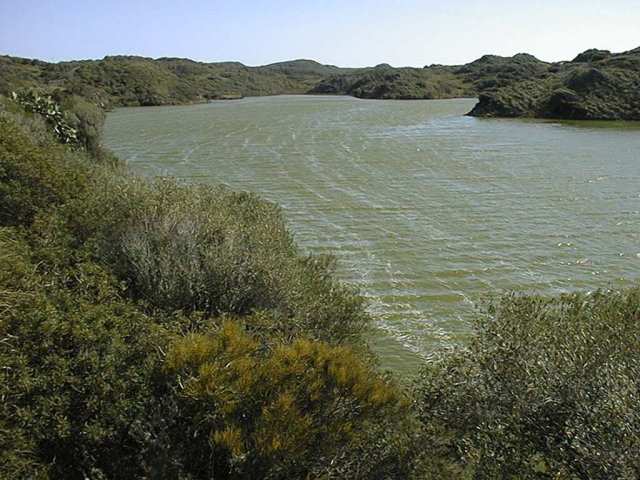
Near the fishermen's houses, we have a wide view towards the lagoon, and also towards the communication channel with the sea, Sa Gola, surrounded by terrestrial plant communities. This lagoon has a well-defined position within the water cycle: we could consider it the sink of the cycle, where all marine inputs end up to equalize the level of both basins, the lagoon and the marine littoral. This is because the rainfall regime of our latitude is markedly seasonal, being torrential, brief, and of great intensity. How will soil behave with this type of rainfall? It will soon become saturated with water, and the rest—hardly capable of being received by a soaked soil—will flow superficially through the torrents, downhill, accentuated if the type of substrate is not very permeable (it belongs to the Menorcan silicic country). But there will also be long seasons, especially in summer, where rain is almost a miracle and the soils of the basin find their water reserves almost exhausted. It is then that the only water reserve for the lagoon, now condemned to desiccation by high evaporation, is the sea, which, having plenty of water, could be said to invest a surplus in the lagoon, which prevents it from drying out during the summer. But the sea gains from this investment: when the rains arrive, the water from Sa Gola returns to the sea loaded with nutritive elements that will enrich the biomass of the coastal marine communities. This reverse process, therefore, provides a benefit. The aquatic ecosystem, by the fact of existing, is in communication with a drainage basin, which supplies nutritive ions to the lagoon. It is a process linked to the continuous erosion of the soils, originated by rainwater drainage and accelerated or intensified by man, who eliminates the vegetation cover of a good part of the terrestrial ecosystems. These nutritive materials, exposed to light, will allow the growth of aquatic plant communities on top of the lagoon's sediment: hence the great production it presents. In contrast, in the sea, nutritive elements accumulate at the bottom, where sunlight no longer reaches beyond a certain depth, thus sealing off the possibility of an enormously productive ecosystem. The shallow depth of the lagoon, 2 to 3 meters, allows for total illumination of the ecosystem, and it can be said that there is no moment of rest for utilizing these materials essential for life. The lagoon thus becomes a very productive ecosystem, with the capacity to feed a large number of organisms. The plant community is different from the terrestrial one and can assume two states, depending on the degree of water exchange with the sea: when this is small or nonexistent, with Sa Gola being collapsed by sand in its section that crosses the beach, the community is based on microscopic organisms that dye the water green, reducing its transparency. Although its biomass is small, its reproductive potential is so high that it can double in a day; seen from the perspective of consumers (animals), the small biomass does not present any problem, as they can consume it entirely without harming it. When, on the contrary, the flow with the sea is large, this planktonic community is quickly carried away by the current, forming a filamentous green algal plant community attached to the bottom, along with submerged herbaceous plants rooted in the sediment. The water is more transparent and, in general, we can say that it benefits the life of large animals, which are guided by sight in their food captures: herbivores seek tubers and roots, carnivores seek mosquito larvae or fish.
The marsh from the Sa Gola bridge

The humid shores, as water flows through Sa Gola, can be differentiated according to their plant composition. Basically, there is, from the bridge looking inland, a community different from the glasswort marsh. It is a group of plants not as influenced by saltwater, but also growing on flooded land; it is strictly a small marsh, composed of rushes in its lower and closer part, and immediately followed by a uniform cover of common reed and cattail (Phragmites australis and Typha latifolia). We will also see, if we approach by road, other associated plants typical of this environment, which provides good shelter for birds: this is the case of one or two species of bindweed (Convolvulus ssp.), the bramble (Rubus ulmifolius), a spurge different from the one on the beach and in the wild olive forest and scrub (Euphorbia ssp.), etc.
Inland shrubby scrub

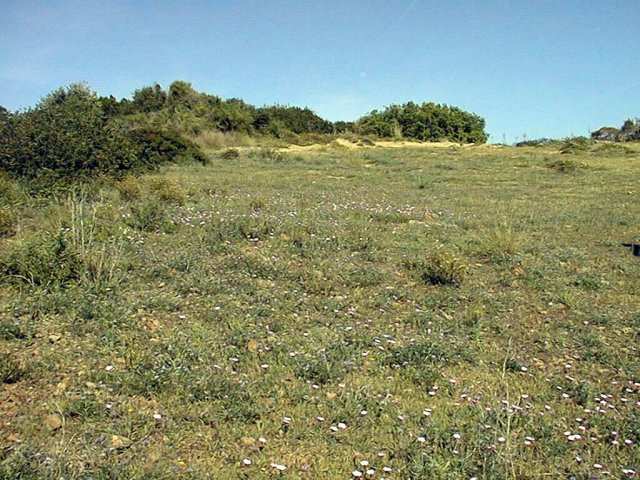
We are facing a variety formed by the juniper forest itself and a mixture of shrubby scrub, more undefined and complex than that observed on the western coast of the beach. These characteristics and others mean that we cannot identify it as a pure community, given its current state of growth. We see how the sand, initially dragged by the wind and then colonized by vegetation, rides over the silicic substrate of slate. The floral composition of the scrub adjacent to the dune front is quite diverse. We find the two pine species again, and also other abundant plants, which we highlight because we have not mentioned them yet throughout the itinerary: the heather (Erica multiflora), rosemary (Rosmarinus officinalis), Mediterranean buckthorn (Rhamnus alaternus), rockrose (Cistus laurifolius), the herb Dorycnium pentaphyllum, etc. We observe that the holm oak also appears, which plays a different role here than its residual presence in the pine-juniper forest; its abundance within the scrub as well as an incipient level of growth above the rest of the shrubs seems to augur a future protagonism in the search for greater stability and ecological maturity.
The fauna
As expected, the most important fauna of the lagoon are the aquatic birds, and this is reinforced by Menorca being a station, a stop on the long journey of migratory birds, and, naturally, the wetland area of the lake is the most favorable for resting and replenishing energy. The presence of other more regular birds finishes shaping the aerial landscape; we refer to the osprey (Pandion haliaetus), the European shag (Phalacrocorax aristotelis), blue rock thrush (Monticola solitarius), rock dove (Columba livia), warblers (Sylvia ssp.), tawny pipit (Anthus campestris), stone-curlew (Burhinus oedicnemus), Thekla's lark (Galerida theklae), short-toed lark (Calandrella brachydactyla), the turtle dove (Streptopelia), common pochards (Aythya ferina), Eurasian wigeon (Anas penelope), common coot (Fulica atra), mallard (Anas platyrhynchos), common teal (Anas crecca), and herons (Ardea purpurea). Raptors such as the red kite (Milvus milvus), booted eagle (Hieraaetus pennatus), little grebe (Tachybaptus ruficollis), or the peregrine falcon (Falco peregrinus) are also usually observed. Regarding fish, the most common species of s'Albufera are the eel (Anguilla anguilla), the flathead grey mullet (Liza aurata and L. ramada), the European sea bass (Dicentrarchus labrax), the sandsmelt (Atherina boyeri), the golden grey mullet (Liza saliens), and the western mosquitofish (Gambusia affinis holbrooki), the latter introduced by man. The most representative mammals are the rabbit (Oryctolagus cuniculus), the brown rat (Rattus norvegicus), the Algerian hedgehog (Atelerix algirus), the garden dormouse (Eliomys quercinus), and the pine marten (Martes martes). Regarding reptiles and amphibians, the European green toad (Bufotes balearicus), the European pond turtle (Emys orbicularis), the Italian wall lizard (Podarcis sicula), the false smooth snake (Macroprotodon cucullatus), the ladder snake (Rhinechis scalaris), and the Mediterranean tree frog (Hyla meridionalis) stand out.
The human activity of the park
Here we can speak of two well-defined activities: one is agricultural, and the other is the population of the coast with weekend and/or summer season houses. Regarding agricultural activity, it is more or less traditional, shaping part of the almost natural landscape of the park and does not represent a danger to it in current uses. Regarding coastal settlements, the pressure has been greater, to the point of having had to recover a significant part of the park's territory through expropriation. Traditional settlements are maintained, but the increase in tourism is also felt on the coasts and the Des Grau beach, a Menorcan corner that has a significant tourist presence despite not having hotels nearby. The beach, formed by a pronounced inlet of the sea, which ends up forming a shell of very shallow depth and little water renewal, makes it favorable for the first swims of the season, since its waters warm up more quickly. It should also be noted that as it is a very shallow beach, it is ideal for children and the elderly who are not willing to fight the waves and who prefer these calm waters. The sunset is one of the most beautiful spectacles in these calm waters, where the fishermen's boats rest gently, and even the nervous motorboats of the nervous occasional visitors—and not so occasional—are also seen swaying to the rhythm of infinitesimal waves, which reflect the last rays of the sun, flooding the Mediterranean with color, the dunes, the mountain slopes, and even the sky itself gets stained, and like a kind of curtain, the stage of the theater is being covered by the night, slowly, very slowly.
More about the Albufera Des Grau
The famous Camí de Cavalls, formerly intended for the surveillance of the Menorcan coast, also passes through the natural park and is ideal for walking around s'Albufera des Grau, passing near the flooded area, s'Illa d'en Colom, the Morella pond, the Torre dels Tamarells, and the Sa Torreta sites. On the Sa Torreta estate, we can find a talayotic complex with great archaeological and historical importance; and not far from it, a defense tower on the Sa Torre Blanca estate. At the end of the Rambla cape, opposite the illa d'en Colom, we find a defense tower near the sea, at a height of about 25 meters above sea level. It is the Torre dels Tamarells, also known as Torre de Sa Torreta or Torre de Rambla. It is a construction dating from the 18th century, truncated conical, with "marès" stone reinforcements on the exterior and which has three floors, with the main entrance on the middle one. Also standing out, in the ethnological field, are the dry-stone walls, the houses of Sa Bovaleta and Sa Boval Vella, and the wells and troughs for animals.